These are the rules of Cry Havoc as this site applies them. They use the rules of the Vikings box (Euro Games, 1990). These rules are fairly complete without being too heavy. Everything Vikings does not cover is taken from the Cry Havoc base box.
Blue boxes like this one present the rules set up specifically for this site: what it applies differently from the rulebook, or what it specifies where the rulebook says nothing.
1. Components
The die
One 10-sided die (0 counts as 10).
The maps
A hex containing several types of terrain counts as the terrain that covers most of it.
The counters
Each counter represents a specific character. A turn lasts a few dozen seconds; a hex is two metres wide, enough for a man on foot to wield his weapon, but not for a rider, who therefore occupies two hexes.
A character on foot is shown by four distinct images: fit, stunned, wounded and dead. A character with a mount has eight: the four on foot, and four mounted (fit, wounded, the riderless horse and the dead horse). Each image shows:
- a black number: the attack strength;
- a red number: the defence strength;
- a blue number: the movement points.
The top of a mounted counter shows the horse's head, and so the direction of movement.
2. Playing a game
The players choose a scenario, set up the map and the characters. A game is a series of turns; each turn has one phase per side. During a phase, a player makes his or her characters shoot, move and fight.
3. Turn sequence
Player A's phase (then the same for player B):
- Missile fire. All archers of side A may shoot, except those in contact with an enemy.
- Movement. All characters of side A may move.
- Combat. All characters of side A in contact with an enemy may attack it.
- Stunned characters. Characters of side A stunned during B's phase recover.
A sequence may only start once the previous one is over.
- No defensive fire (in Vikings, player B may shoot at side A's characters while they move): this limits the back and forth between the two players, each one plays a whole turn in one go.
- Crossbowmen (absent from Vikings) follow the base rules: they shoot in sequence 1, and a crossbowman who has shot does not move in sequence 2.
4. Missile fire
Who shoots
Each shooter shoots once per fire sequence; several shooters may aim at the same target. A character on a hex next to an enemy cannot shoot: he is busy fighting. The shooter may still shoot if that enemy is not allowed to attack him, for example when a wall stands between them (see Combat restrictions). A wounded shooter can still shoot, even if his counter shows him without a bow.
A stunned or dead enemy does not count (it cannot attack); neither does an enemy behind a wall. Through a window, it counts (combat is possible through a window).
Line of fire
A straight line from the centre of the shooter's hex to the centre of the target's hex. If it crosses a character or any terrain other than open ground, see the restrictions below.
To keep the calculations simple, terrain boundaries are the sides of the hexes. For example, the line of fire is not checked against the drawing of a wall: the side of the hex is the limit of the real wall.
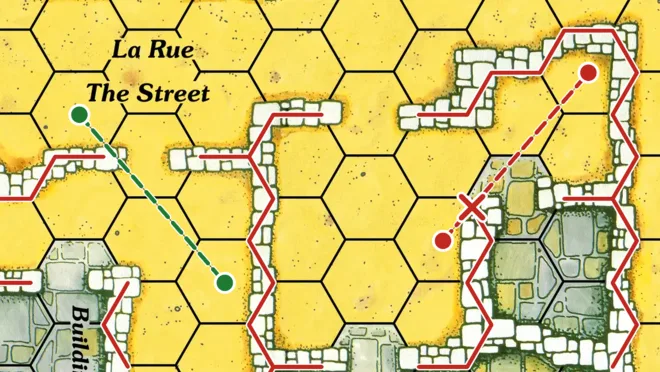
On this piece of the Village map, in red, the walls as the site counts them: the sides of the hexes. The green shot goes over drawn stones but crosses no red side: it is allowed. The red shot seems to run alongside the drawn wall, but it crosses a red side (the cross): it is blocked.
- The line of fire is shown on screen when a target is chosen.
- When the line of fire runs exactly along the side between two hexes, or exactly through a corner, there is no telling which side it passes on. It then counts as crossing every hex it touches: if there is an obstacle (tree, wall, character) in any of them, the shot is blocked. The benefit of the doubt goes to the target.
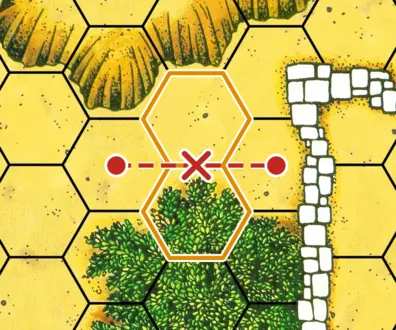
Here, the line of fire runs exactly along the side between two hexes (outlined in orange): open ground above, a tree below. It counts as crossing both hexes: the tree blocks it (the cross), even though it seems to pass beside it.
Die modifiers
| Situation | Die |
|---|---|
| Bow, 1 to 10 hexes | normal roll |
| Bow, 11 to 25 hexes | +1 |
| Bow, 26 to 50 hexes | +2 |
| Wounded shooter | +1 |
| Armoured target | +1 |
The crossbow (absent from Vikings) uses the Magna Carta ranges: 1 to 15 hexes normal roll, 16 to 30 hexes +1, 31 to 75 hexes +2; beyond that, no shot. It never shoots over a character, even at long range (see Characters, below).
Table symbols. In the results tables, the letters of the rulebook are replaced by symbols, which are easier to read. In blue, the attacker suffers the result; in red, the defender or the target.
| Symbol | Meaning | Rulebook letter: fire | Rulebook letter: combat |
|---|---|---|---|
| the target or the defenders retreat | A | C | |
| the attackers retreat | B | ||
| stunned | D | ||
| wounded | B | E | |
| one attacker wounded | A | ||
| killed | C | F | |
| horse killed (with another symbol, against a rider) | |||
| - | miss, or no effect | - | - |
Against a rider, the rulebook letters are different: each symbol reads the same way, and the horse head is added when the horse is killed.
Fire table against characters on foot (bow)
| Modified roll | None | Light | Medium | Heavy |
|---|---|---|---|---|
| 1 | ||||
| 2 | - | |||
| 3 | - | |||
| 4 | - | - | ||
| 5 | - | - | - | |
| 6 and + | - | - | - | - |
Results: - miss; the target retreats 2 hexes; the target is wounded; the target is killed.
- This table is identical to the base rules table for the bow.
- The "heavy" column is not used by any terrain on our maps for now.
- The crossbow (absent from Vikings) uses the Magna Carta table, the same as the bow's but read 4 rows higher ("bow 1" = "crossbow 5"): much deadlier, especially at close range. Armoured target: +1 to the die, as for the bow.
| Modified roll (crossbow) | None | Light | Medium | Heavy |
|---|---|---|---|---|
| 1 | ||||
| 2 | ||||
| 3 | ||||
| 4 | ||||
| 5 | ||||
| 6 | - | |||
| 7 | - | |||
| 8 | - | - | ||
| 9 | - | - | - | |
| 10 and + | - | - | - | - |
Fire table against mounted characters
| Modified roll | None | Light | Medium |
|---|---|---|---|
| 1 | |||
| 2 | |||
| 3 | - | ||
| 4 | - | - | |
| 5 and + | - | - | - |
Results: - miss; the rider retreats 4 hexes; horse unhurt, rider stunned and unhorsed; horse unhurt, rider wounded; horse killed, rider wounded and unhorsed.
- The rider always has the stronger cover of his two hexes; either hex may be targeted.
- The crossbow uses the Magna Carta table, read 4 rows higher than the bow (as on foot): at close range it can also give (horse unhurt, rider killed) and (horse and rider killed):
| Modified roll (crossbow) | None | Light | Medium |
|---|---|---|---|
| 1 | |||
| 2 | |||
| 3 | |||
| 4 | |||
| 5 | |||
| 6 | |||
| 7 | - | ||
| 8 | - | - | |
| 9 and + | - | - | - |
Retreat after fire (result )
The target immediately retreats 2 hexes (4 for a rider). It may pass through hexes with friends, and even move a friend aside to reach the required distance. If it (or a friend moved aside) passes or stops next to an enemy, it must take the infiltration test. It never passes through an enemy. If it cannot retreat the full distance, it is wounded. A stunned or wounded character who is wounded or stunned again is killed; a stunned character forced to retreat is killed.
The retreat is automatic: each step moves away from the shooter; the path needing the fewest infiltration tests is chosen, then the one that pushes no one; a friend moved aside moves one hex; a stunned friend is never pushed (he would be killed).
5. Fire restrictions and cover
Trees. A tree (or tree branches) between shooter and target makes the shot impossible. A target in a tree hex may be shot if the line crosses no other tree. A target in a tree has light cover.
Scrub. One may shoot into and through scrub. A target in scrub has light cover.
Riders. A rider occupies two hexes; if they do not give the same cover, he always gets the better one (one open ground hex and one scrub hex: light cover).
Houses: shooting through a window.
- From inside, one may only shoot outwards from a hex next to a window; the line starts from the middle of the outer sill of the window.
- From outside, one may only shoot through a window at a target just behind it, and the line must reach the centre of its hex without touching a wall. A shooter standing outside right against the window may shoot into the room; the line starts from the middle of the inner sill.
Houses: shooting through a door. A shot from a door hex starts from the centre of the hex (our door hexes have several open sides, so there is no single "opening").
Houses: cover. A target inside a building has medium cover when shot at through a door or a window. A target on a door or courtyard entrance hex always has medium cover, whichever side the shooter is on.
Walls. Walls block the line of fire; a character behind a wall with no opening cannot be targeted.
Characters. At short range, a line crossing a standing character (man or animal) makes the shot impossible. Stunned and dead characters do not block. At medium or long range, archers may shoot over other characters. Exception: a shooter on a slope who cannot see a character below may freely shoot over him.
The crossbow (base rules) never shoots over a standing character.
Slopes. A slope hex does not block as long as the line does not cross the top of the slope. If it does, the shot is only possible if the character below is at least as far from the slope hex as the character above; otherwise they cannot see each other. Exception: a character on the slope hex itself may shoot and be shot at (he is half way up); he then has medium cover if the line crosses the top of the slope.
The top of the slope is the hex side between the slope (the slope hex) and the ground above it. A character on that side, above the slope, is higher; a character on the other side, on the slope or below it, is lower.
- If the shooter and the target are each at the top of a slope, with a dip between them, they are at the same height: the shot is allowed.
- If the line crosses several slopes rising in the same direction, like steps, the distance rule applies to each of them.
6. Movement
Each hex entered costs movement points according to its terrain. A player may move all or some of his or her characters, using all or part of their points; unused points are lost.
Terrain types
| Terrain | Movement point cost | Cover | Combat |
|---|---|---|---|
| Open ground | 1 | none | 0 |
| Scrub | 2 | light | - |
| Slope | 2; 4 mounted | medium or none (see Slopes) | - |
| Tree | 2; impassable mounted | light | - |
| Building interior | 1; impassable mounted | medium or none (door, window) | + |
| Window | +3; impassable mounted | medium or none | attacker -, defender + |
| Door | 1; impassable mounted | medium or none | defender + |
| Wall | impassable | ||
| Pool (water) | impassable | (shots pass over it) |
- Going through a window costs 3 points, plus the cost of the hex entered, so 4 points to enter a house. The base rules said that wounded characters could no longer go through a window: this is not applied (wounded characters have 4 points).
- The pool on the Crossroads map is impassable to everyone, for now. Vikings distinguishes deep water (where characters can drown) from shallow water (where they can stand); this rule may be added later.
- The mounted costs of the table (slope 4; tree, interior, window and door impassable) apply to riders; see also 7. Mounted characters for turning.
Movement restrictions
- A character may not pass through an enemy's hex, unless the enemy is stunned or dead. Friendly hexes may be crossed freely.
- Walls are impassable: to enter a building, a character must be on foot and go through a door or a window.
- A hex with 3 dead men or 1 dead horse costs 1 extra point; with 6 dead men, or 2 dead horses, or 3 dead men and 1 dead horse, it becomes impassable.
A move may not end on a stunned enemy's hex; an icon marks hexes with 3 and 6 dead; dead horses will come with the horses.
Clearing an impassable hex
Two characters on foot may remove three dead men or one dead horse from a hex. During their phase they do nothing else: no moving, no shooting, no fighting. Not possible if an enemy able to attack is on an adjacent hex.
Stacking
Characters may pass through hexes containing a friend, a stunned or a dead character, but at the end of each movement or combat there may be only one living character per hex.
Infiltrating enemy lines
When a character passes through a hex adjacent to one or more enemies able to attack it, one die is rolled for each enemy:
| Modified roll | Result |
|---|---|
| 1 to 7 | nothing |
| 8 or 9 | wounded |
| 10 | killed |
| Modifiers | Character infiltrating | Character opposing |
|---|---|---|
| Rider | -1 | +1 |
| Armoured character | -1 | +1 |
| Armoured rider | -2 | +2 |
| Wounded character | +2 | -2 |
Only hexes passed through count: the hex where the move ends does not trigger a test. Special cases:
- a rider rolls only once, even though he occupies two hexes; the top of the counter is what counts;
- no test when the enemy is on the other side of a window.
- A stunned enemy is not "able to attack": it does not trigger a test.
- A mule (attack strength 0) cannot attack: it does not trigger a test. Only characters do.
- When a character is selected to move, each hex shows the number of tests needed to get there, and the path followed is automatically the least risky (then the cheapest).
- A character wounded by a test continues to the chosen hex; if killed, he falls on the hex of the test.
- A rider is only tested for the hex of its head (special case 1). An enemy rider threatens the hexes next to its head and to its hindquarters, with a single die.
7. Mounted characters
Turning the horse
A mounted character occupies two hexes: the hex of the horse's head (the top of the counter) and the hex of its hindquarters. Moving to the hex the top of the counter points to, or to one of the two hexes beside it, costs the normal price. Turning more sharply costs 1, 2 or 3 points more than the price of the hex; a full about-turn on the spot costs 3 points.
| Hex the horse's head enters | On top of the hex price |
|---|---|
| Ahead, or diagonally ahead of the head | nothing |
| On a flank (hex touching both head and hindquarters) | +1 |
| Diagonally behind the hindquarters | +2 |
| Behind the hindquarters | +3 |
| Full about-turn on the spot | 3 points in all |
- After each step, the head is on the chosen hex. The hindquarters take the head's former hex when they touch it; otherwise (hexes behind the hindquarters), they stay put: the horse pivots on its hindquarters. On an about-turn on the spot, head and hindquarters swap places.
- Both the head and the hindquarters must always be on hexes allowed to horses, never on a standing enemy. Friends may be crossed but not stopped on.
- To move a rider, each hex its head can reach is split into six parts: clicking a part chooses the hex of the head and the side it faces. The red number in a part gives the number of infiltration tests; on hover, the rider appears transparently at its arrival position, and its cost is shown at the top. The path followed is the least risky, then the cheapest.
Retreat and advance of a rider
A rider retreats one hex in melee, and 4 hexes when a shot makes it retreat. After a won combat, it may advance 3 hexes (2 on foot).
The booklets give these distances, but not how to move a two-hex counter. On the site:
Retreat. The horse does not turn round: for each hex of retreat, the head and the hindquarters slide together one hex in the same direction, and the horse keeps its facing. It must move away from the opponent: after each hex, it is farther from the nearest enemy (in melee, among those of the combat; for a shot, from the shooter). Both the head and the hindquarters arrive on hexes allowed to horses, with no wall to cross, never on an enemy; it may cross a friend but not stop on one (a horse does not push its friends). In melee, neither hex may touch an enemy of the combat. When several retreats are possible, the choice is automatic: the fewest infiltration tests (judged on the head), then the farthest from the opponent, then preferably towards the hindquarters. If no retreat is possible, the rider stays where it is and is wounded.
Advance. The head first enters the hex left by the enemy (or the hex of the stunned or killed enemy), then advances one or two more hexes; the hindquarters always follow the head. Hexes are counted, not points: no turning cost, but no pivoting on the hindquarters either. As for movement, each possible hex is split into six parts: one click chooses the hex of the head and its facing. Infiltration: only the head counts, and only enemies not engaged in a combat roll the die.
For now, the retreat after a shot is 2 hexes, as on foot: the 4 hexes will come with the shooting table against riders.
Examples (the horse faces north: the head is above the hindquarters)
- Frontal attack. A foot soldier, north of the head, wins the combat ( result). The horse backs straight towards its hindquarters: the hindquarters move one hex down, the head takes their place. It still faces north, towards the enemy.
- Flank attack. The enemy is south-east of the head. Backing straight would not take it far enough: the horse slides south-west, to the other side, still facing north.
- Shot from behind. An archer to the south makes it retreat. Moving away from the shooter means going north: the horse moves two hexes in the direction of its head.
- Cornered horse. Enemies to the north, north-east, south-east and north-west of the head, a friendly mule to the south-west: no direction takes it away from the opponent without ending next to an enemy or on a friend. The rider does not retreat: it is wounded.
- Advance. The rider has made an enemy in front of its head retreat. Its head enters the vacated hex, then it may go on one or two hexes, turning if it wishes; it ends with its head on the chosen hex, facing the chosen way.
Mounting and dismounting
To mount, the character must be on a hex next to the horse, and neither the rider nor the horse may be next to an enemy able to attack; the two counters are then replaced by the mounted counter. Only a rider may mount another character's horse. To dismount, the mounted counter is flipped and the rider on foot is placed on a free adjacent hex, with no restriction.
Mounting or dismounting costs 2 points for a light rider (no armour), 3 for a heavy rider (armoured), deducted before the change. Then:
- when mounting, the points left on foot are doubled;
- when dismounting, the points left mounted are halved (quartered if the character is wounded), rounded down.
Example: a rider with 15 points rides 4 hexes (6 points) and dismounts: 15 - 6 = 9 points left, halved = 4 points on foot.
Riderless horses
A riderless horse stays still until it is mounted or led by the bridle. To lead it, a character, even wounded, only has to pass on a hex next to the horse (not possible if an enemy able to attack is near the horse); the horse then follows as an extension of the character's counter. It stays with the same side as long as a living, standing character of that side is right next to it; otherwise it belongs to the first player to take control of it. A rider leading another horse lets it go if he takes part in a combat. A character on foot may lead up to three horses, a rider only one.
Unhorsed riders
A rider unhorsed by fire or combat is placed (stunned, wounded or dead, according to the result) by his player on a hex next to his horse; if they are all occupied, a friend is moved one hex aside; if he is completely surrounded by enemies, he is killed. The horse stays where it is, alone, alive or dead according to the result.
- The rider is placed automatically on the free hex next to the horse that is farthest from enemies. If no hex is free, he is killed (a friend is not yet moved aside to make room).
- A rider killed in the saddle (by an infiltration test, for example) falls on the hex of the head; his horse stays alone.
- For now, a lone living horse occupies its two hexes: nobody may cross or stop there, and it does not move (mounting, leading by the bridle and attacking a lone horse will come later). A dead horse counts as 3 dead men on each of its two hexes.
Attacking a riderless horse
It is treated as a mounted character; for fire, results and , and for combat, results , , and , kill the horse.
8. Combat
Two characters on adjacent hexes may fight; combat is always optional and decided by the player whose turn it is (the attackers). Each character attacks once per turn, but a defender may be attacked several times.
Divide the attack (black number) by the defence (red number), rounding in the defender's favour (8 against 3 = 2 to 1). Below 1 to 1, the attack is impossible. Roll the die in the column of the odds, in the table against characters on foot or against mounted characters.
A preview shows the odds before the attack is confirmed.
Terrain effects
Each terrain is neutral (0), favourable (+) or unfavourable (-). The column is shifted according to the attacker's and the defender's terrain:
| Attacker | Defender | Shift |
|---|---|---|
| - | + | 2 columns left |
| - | 0 | 1 column left |
| 0 | + | 1 column left |
| 0 | - | 1 column right |
| + | 0 | 1 column right |
| + | - | 2 columns right |
Equivalent terrain: no shift. A rider counts as being on the less favourable terrain of his two hexes.
If the terrain brings the odds below 1 to 1, the combat is impossible (the rule says nothing about this case), except with the option "Attacks possible below 1 to 1" (see under the melee table on foot). With the Sherwood table, if chosen (see below), any attack is allowed.
Combat with several characters
A character adjacent to several enemies may attack some, all or none of them; if he attacks several, their defences are added together. Several characters may attack one enemy one after the other, or together by adding their attacks: together, they also shift the odds one column to the right (against a rider, only if the attackers are themselves several riders). When a result affects only one character (wounded, stunned), his side chooses which one; a retreat applies to all. Several attackers on different terrains use the least favourable one.
- Never several attackers against several defenders; each attacker must be in contact with each defender.
- Several defenders on different terrains use the most favourable one.
- When a result hits only one character, that character is always drawn at random instead of being chosen (no pause in the middle of the turn to let anyone choose).
Armoured defender
The attacker adds 1 to the die, unless the defenders are not all armoured.
Combat through a door or a window
Through a door, the defender is always favoured (+), inside or outside. Through a window, the defender is favoured (+) and the attacker unfavoured (-).
"Through a door": one of the two fighters is on the door hex.
Combat table against characters on foot
| Die | 1-1 | 2-1 | 3-1 | 4-1 | 5-1 | 6-1 | 7-1 | 8-1 | 9-1 | 10-1 | 11-1 | 12-1+ |
|---|---|---|---|---|---|---|---|---|---|---|---|---|
| 1 | ||||||||||||
| 2 | ||||||||||||
| 3 | ||||||||||||
| 4 | ||||||||||||
| 5 | ||||||||||||
| 6 | ||||||||||||
| 7 | - | |||||||||||
| 8 | - | |||||||||||
| 9 | - | - | ||||||||||
| 10 | - | - | - |
+1 to the die if the defender is armoured (10 + 1 stays 10).
Option: attacks possible below 1 to 1 (Vikings table only, ticked by default when creating the game)
With this option, you can always attack, even at very bad odds, but you risk your life. Two columns are added to the left of the table: 1-2 (the defence is up to twice the attack) and 1-3 (the defence is more than twice the attack, and any even weaker attack). Terrain can also shift an attack into these columns, never further than 1-3. New result: one attacker is killed (drawn at random).
| Die | 1-3 or worse | 1-2 |
|---|---|---|
| 1 | ||
| 2 | ||
| 3 | ||
| 4 | ||
| 5 | ||
| 6 | ||
| 7 to 10 | - | - |
The 1-2 column is the 1-1 column moved up one row, with one attacker killed on a 6; the 1-3 column is the 1-2 column moved up one more row, with a second death: the only good result is to make the enemy retreat.
Results: - no effect; one attacker wounded; the attackers retreat one hex; the defenders retreat one hex; one defender stunned; one defender wounded; one defender killed. In blue, the attacker suffers the result; in red, the defender.
When creating the game, you choose the combat table. Nothing is ticked in advance.
- Vikings (table above): you divide the attack by the defence (2 to 1, 3 to 1…). No attack below 1 to 1. Advantage: many retreats, few deaths at middling odds, room to manoeuvre; several attackers against a weak defender kill quickly. Drawback: a character weaker than its opponent can never attack it alone.
- Sherwood (table below), the system of the recent boxes of the series (Guiscard, then Sherwood): you subtract the defence from the attack. Any attack is allowed, even when outmatched. Advantage: everyone can attack, and as soon as the points gap is large, combats are bloodier. Drawback: attacking when outmatched puts the attacker at risk (retreat or wound on high rolls), and a strong character against a very weak one kills less quickly than with Vikings.
Terrain and several attackers shift the column as with Vikings. A shift that goes off the table stops at its first or last column. The results are the same.
| Die | below -5 | -5 to -1 | 0 to 4 | 5 to 9 | 10 to 19 | 20 to 29 | 30 to 39 | 40+ |
|---|---|---|---|---|---|---|---|---|
| 1 | ||||||||
| 2 | ||||||||
| 3 | - | |||||||
| 4 | - | - | ||||||
| 5 | - | - | - | |||||
| 6 | - | - | - | |||||
| 7 | - | - | - | |||||
| 8 | - | - | - | |||||
| 9 | - | - | - | |||||
| 10 | - | - |
Against a mounted character (Sherwood), by the same difference (several mounted attackers: one column to the right):
| Die | below -5 | -5 to -1 | 0 to 4 | 5 to 9 | 10 to 19 | 20 to 29 | 30 to 39 | 40 and + |
|---|---|---|---|---|---|---|---|---|
| 1 | ||||||||
| 2 | ||||||||
| 3 | - | |||||||
| 4 | - | - | ||||||
| 5 | - | - | - | |||||
| 6 | - | - | - | |||||
| 7 | - | - | - | |||||
| 8 | - | - | - | |||||
| 9 | - | - | - | |||||
| 10 | - | - |
(Sherwood only): horse killed, rider stunned and unhorsed; the other symbols read as in the Vikings mounted table.
Combat table against mounted characters
| Die | 1-1 | 2-1 | 3-1 | 4-1 | 5-1 | 6-1 | 7-1 | 8-1 | 9-1 | 10-1 | 11-1 | 12-1+ |
|---|---|---|---|---|---|---|---|---|---|---|---|---|
| 1 | ||||||||||||
| 2 | ||||||||||||
| 3 | ||||||||||||
| 4 | ||||||||||||
| 5 | ||||||||||||
| 6 | ||||||||||||
| 7 | - | - | ||||||||||
| 8 | - | - | - | |||||||||
| 9 | - | - | - | - | ||||||||
| 10 | - | - | - | - | - |
+1 to the die if the defender is armoured (10 + 1 stays 10). Several mounted attackers: one column to the right.
- In a game played with the Sherwood table, the Sherwood mounted table is used against a rider (with the other Sherwood tables, above).
- With the option "Attacks possible below 1 to 1", the 1-2 and 1-3 columns are also added to the left of this table, on the same principle and with the same results as for the table on foot.
Results: - no effect; one attacker wounded; the attackers retreat one hex; the defenders retreat one hex; horse unhurt, rider stunned and unhorsed; horse unhurt, rider wounded; horse killed, rider wounded and unhorsed; horse unhurt, rider killed and unhorsed; horse and rider killed.
Retreat after combat
The retreat applies to all characters involved. They may pass through friends and move them aside to make room; passing or stopping next to an enemy requires the infiltration test. A character may not pass through an enemy, nor retreat next to an enemy who took part in the combat. If the retreat is impossible, the character stays where he is and is wounded. A stunned character forced to retreat is killed.
The retreat hex is chosen automatically (fewest tests, then without pushing a friend, then furthest from the opponents); a friend moved aside moves one hex; a stunned friend is never pushed.
Advance after combat
If the attackers or the defenders had to retreat (or if one of them was stunned or killed), the winner may advance one or more of his or her characters 2 hexes (3 when mounted). The first hex entered must be a hex left by the enemy (if there are several, any of them) or the hex of a stunned enemy, which is stepped over without stopping on it. The character may not return to its starting hex. The advance is optional but must be made at once, before the other combats; only characters who took part in the combat may advance, and this does not prevent them from moving normally in their own turn. For an advance of more than one hex, the infiltration rule applies, except against enemies engaged in a combat at the same time (whether it has already taken place or not).
- Only attackers advance: the defender's advance, when it is the attackers who retreat or die, is removed (it would require handing the game over to the defender in the middle of the turn; it is rarely used).
- Hexes are counted, not movement points; walls and impassable terrain remain forbidden.
- "An adjacent hex" (Vikings text): the adjacent hex the enemy has just left, not a hex next to it.
- "Engaged in a combat": in contact with a character of the advancing side, other than the one advancing.
Combat restrictions
A combat is impossible when the attacker could not move into the hex he attacks: for example, a rider cannot attack a character in a tree.
- A rider only attacks if he could ride into a hex of the defender that touches him: no tree, building interior or door, and no attack through a window.
- A rider can be attacked through his head or his hindquarters: touching either of his two hexes is enough.
- A rider and a character on foot cannot be attacked together (neither Vikings nor the Magna Carta say which table to use): attack them separately.
The Vikings rules, on which this site is based, are available on the Cry Havoc Fan site (page in French): Vikings on cryhavocfan.org.